Stay updated with the latest - Click here to follow us on Instagram

Journalism of Courage
 6 min read


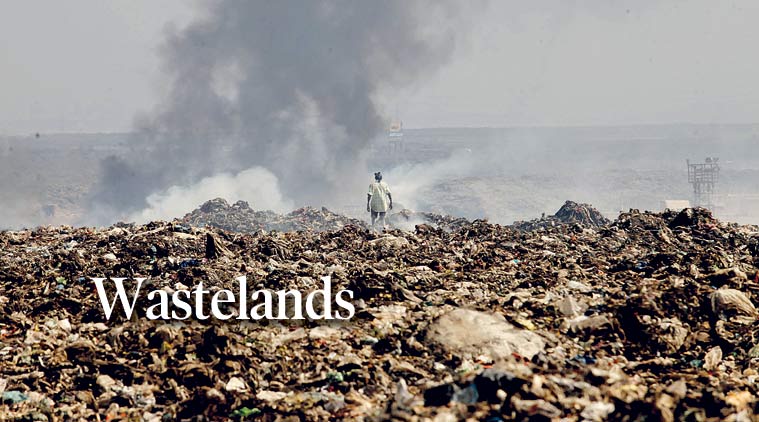 Deonar dumping ground in Mumbai. (Source: Express)
Daily Waste: 9,600 Tonnes
No. of landfills: 3 – Deonar, Mulund and Kanjurmarg.
The Deonar dumping ground, which was ablaze for days starting January 28, has been in operation since 1927. It will soon be 90 years old, a mostly unheard of age for landfills. In parts of Deonar, garbage heaps stand 15 metres high, as tall as a five- or six-storey building. It is sprawled across 132 hectares in a densely populated eastern suburb of the city, with slums on its fringes as well as plush homes less than a couple of kilometres away.
The Mulund landfill, which the Brihanmumbai Municipal Corporation (BMC) has promised to consider closing down — though nearly 2,600 tonnes get dumped here daily — has been functional since 1968. It’s barely 25 hectares and way past its use-by date.
Read: Wastelands of India – Here’s how metros manage their trash
Kanjurmarg, operational since 2003, is spread over 141 hectares and is the only one of Mumbai’s three dumps where mountains of garbage do not stand 10 metres tall.
Agency responsible: The Shiv Sena-held Brihanmumbai Municipal Corporation.
At the landfills
The three operational landfills in the city receive construction debris (over 3,000 tonnes a day), household waste, litter, waste from public bins and other kinds of refuse, equalling the weight of about 1,750 African elephants. Everyday. For decades.
All three dumps are subjects of litigation in the Bombay High Court — residents in localities nearby have opposed them, activists have demanded their closure, the BMC has vacillated and the courts have repeatedly passed strictures.
Early this year, the BMC sought further extensions for the Deonar and Mulund dumps. While granting the extension — from January 31, 2016, to the end of February — the court said, “We keep granting extensions as no authority is taking this issue seriously.”
At Kanjurmarg, a bio-reactor waste processing facility with a capacity of approximately 3,000 tonnes per day generates gas/fuel from waste. Composting of wet waste will start this year.
However, scientific closure plans initiated previously at Deonar and Mulund have run into multiple problems. In 2009, a Rs 3,700-crore contract for partial closure — total closure hinges mostly on finding alternative sites — and for constructing an ‘integrated waste management facility’ was given to United Phosphorus Ltd. But the BMC, led by the Shiv Sena, ran into a wall of resistance from the then Congress-NCP state government. So while the BMC wrote 24 reminders to the state government seeking permission to lease the Deonar land to the private firm, no decision was taken. Even an affidavit in the Bombay High Court stating that the state had to take a decision on the move did not yield a decision. Last month, the civic body terminated contracts for both these dumping grounds. New tenders will now have to be floated.
Looking for alternative sites hasn’t been easy either. The municipalities of Thane, Vasai-Virar and others have hotly opposed previous attempts to locate lands in their vicinity for Mumbai’s garbage.
Six years ago, the Mumbai Metropolitan Region Development Authority (MMRDA) planned a regional landfill that multiple municipal corporations in the region could use. This facility was to come up on a 107-hectare plot in Taloja, in Navi Mumbai. It was designed to process 2,500 tonnes of daily waste and convert it to electricity. But six years into planning, the project is nowhere near ready. Apart from Mumbai, other local bodies that were to use the site were Bhiwandi-Nizampur, Thane, Kalyan-Dombivli, Ulhasnagar, Ambarnath and Kulgaon-Badlapur. These cities, it is anticipated, will together generate 5,000 tonnes of waste per day by 2035.
The MMRDA hoped the facility could be eventually expanded to Mumbai and Navi Mumbai too, but the project has proven to be a non-starter.
Municipal corporations found the tipping fee — the payment for transferring and processing waste — too steep. MMRDA finally terminated its agreement with the bidder and decided to transfer 38 hectares to the BMC for the latter’s landfill.
But even as Municipal Commissioner Ajoy Mehta says the BMC is set to start using the Taloja plot and another one in Airoli, also in Navi Mumbai, villagers in the semi-urban Taloja have launched an agitation against the proposed shifting of Mumbai’s garbage to their vicinity.
Experts say Mumbai’s waste management needs a complete overhaul. “The city’s municipal corporation is the richest in the world. It should set an example on solid waste management for the rest of the country. Instead, we have blatant violations… There has to be strict action against municipal authorities for the way waste is being disposed of without any treatment, creating a health hazard for its citizens,” says S R Male, an expert on waste management and also member of a High Court-appointed committee on solid waste.
Sporadic fires do break out in all dumping grounds, admit fire officers, though Deonar, with its eight decades of garbage, is most prone to serious conflagrations. The city’s Fire Brigade complains that its recommendations on how to tackle the recurrent fires in Deonar have been mostly ignored. The sporadic fires are also a drag on air quality and consequently on health.
On January 28, as the Deonar fire began, there was a thick cover of smoke even 30 km away from the eastern suburb. Within the next few days, the air quality in Mumbai, as recorded by the System of Air Quality and Weather Forecasting and Research (SAFAR), stood at 341, on a par with Delhi. In the suburb of Chembur closest to the landfill, air quality has remained ‘very poor’ with citizens complaining of eye and throat irritation, breathlessness and other respiratory complications.
Stay updated with the latest - Click here to follow us on Instagram