Journalism of Courage



 Katha Ramachandra Reddy, a member of the central committee of the banned Communist Party of India (Maoist) leader, was allegedly killed in an encounter with the Chhattisgarh police in Narayanpur district’s Abujhmad on September 22. (Special Arrangement)
While his father’s body being transported over 120 km from Narayanpur to Jagdalpur, both in Chhattisgarh, following a Supreme Court directive, didn’t exactly bring him closure, 33-year-old Raja Chandra said it was an important milestone in his quest for justice.
“I just want to know the truth about how my father got killed,” he tells The Indian Express over telephone.
Chandra’s father Katha Ramachandra Reddy, a member of the central committee of the banned Communist Party of India (Maoist) leader, was allegedly killed in an encounter with the Chhattisgarh police in Narayanpur district’s Abujhmad on September 22.
A researcher at the NALSAR University of Law in Telangana, Chandra suspects that his father was “killed in a fake encounter”.
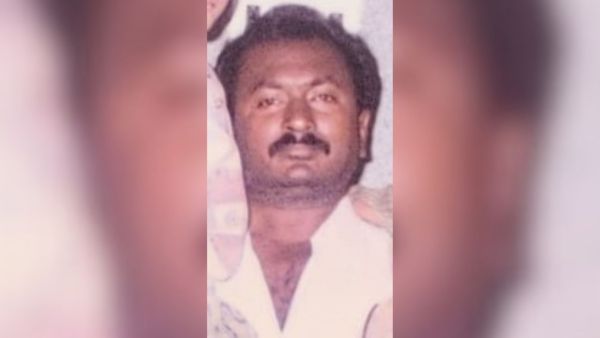 An old family photo of Katha Ramachandra Reddy. (Special Arrangement)
Besides Ramachandra, another member of the banned outfit’s central committee, Kadari Satyanarayana Reddy alias Kosa, was also gunned down in the Maoist stronghold on September 22. The Central Committee is among the top decision-making bodies of the banned CPI (Maoist).
According to the Chhattisgarh Police, the two men were involved in the killings of over 120 security personnel and six villagers. Besides this, multiple states had declared a total bounty of Rs 3.6 crore on them.
Of this, the bounty on Ramachandra, also known as Raju Dada alias Gudsa Ubendi alias Vijay alias Vikalp, was Rs 2 crore. The police said he was responsible for killing nearly 75 security personnel.
With Union Home Minister Amit Shah setting a March 2026 deadline to “wipe out” Maoist insurgency in India, security offensive against members of the party has heightened this year, with several central committee members, including general secretary Nambala Keshava Rao alias Basavaraju, 71, being gunned down on May 21.
Following the news of his father’s death in a police encounter, Chandra, who has done his post-graduation in law, approached the Chhattisgarh High Court on September 24 with a plea to preserve Ramachandra’s body. His petition also called for a post-mortem by the head of the department of forensic medicine at the government medical college in Jagdalpur in Chhattisgarh.
Since the High Court did not allow his plea to be listed immediately and closed for Dasara holidays, Chandra approached the Supreme Court on September 25. Granting him respite, the Supreme Court ordered the Chhattisgarh government to preserve Ramachandra’s body till the High Court hears the son’s plea. The High Court is expected to reconvene on October 6.
On why he suspected that his father was killed in a “fake encounter”, Chandra said he had “multiple reasons”.
He says, “Since the (Maoist) party does not permit its cadres to keep a beard, my father never kept one. However, when his body was recovered, he was sporting a beard. Besides, as a top party leader, he should have been surrounded by his guards.”
Alleging that his father’s torso had burn marks — “a clear sign of torture” — Chandra adds, “We also wanted inquest to be done in the presence of family members. However, the autopsy was already done in Narayanpur before we reached the spot.”
Even the CPI (Maoist) had raised doubts over the circumstances surrounding Ramachandra’s death. In a press release issued on September 23, the banned outfit had accused the Chhattisgarh Police of “torturing” Ramachandra, one of the CPI (Maoist)’s spokespersons, to death.
Ramachandra, who held a bachelor’s degree in science and had also completed his law degree, worked as a school teacher before enrolling as a lawyer with the Chhattisgarh Bar.
While Chandra isn’t exactly sure when his parents joined the CPI (Maoist), he said his father went underground in 2008, while his mother Shanthi Priya was arrested in 2008. In 2008, Chandra said his elder sister was 17 years old, while he was just 15.
“We were a normal family. In fact, our parents never tried to indoctrinate us (his sister and him). We were raised by our extended family after 2008. I was in Class 10 in 2008,” says Chandra, adding that he is not a member of any political party, including the CPI (Maoist).
From Theegalaguttapally village in Telangana’s Karimnagar district, the siblings moved to Hyderabad, nearly 160 km away. In Hyderabad, they continued their education with the help of their relatives.
Recalling one of his last memories of his father — from 2008 — Chandra says, “He used to teach us (his sister and him) social science. While we wanted him to stick to the textbook, he would tell us to think about different perspectives for holistic learning.”
While his fight for “justice” has received the support of lawyers networks and organisations, including the Civil Liberties Committee (CLC), a human rights organisation based in Hyderabad, even his mother, who served 11 years in prison for activities linked to the Maoist party and got out in 2019, is supporting his quest for justice.
Chandra adds, “I will fight this case till the end. I want to get to the root of my father’s death.”




 5 min read